
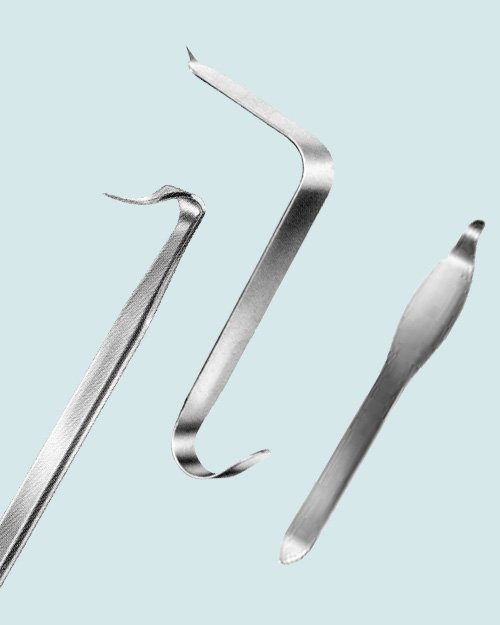
Spine instrumentation tends to be less forgiving of small dimensional variation than many other orthopedic instrument categories, simply because the working space a surgeon has to operate in is smaller and the margin for error around neural structures is lower.
Retractor geometry
Spinal retractors are often designed around a specific approach — posterior, anterior, or minimally invasive — and small differences in blade length, curvature, or depth-marking can materially change how well a retractor performs for its intended approach. A retractor that looks nearly identical to the specified pattern in a photo can behave quite differently in use if the blade angle is off by a few degrees.
Consistency across a set
Where spine sets include graduated instruments — for example, a range of blade or dilator sizes — consistency across the full range matters as much as the accuracy of any single piece. A set where sizes are individually correct but not consistently stepped relative to one another is harder for a surgical team to work with than the size labeling alone would suggest.
Material and rigidity
Instruments used for retraction and manipulation in a confined space need to hold their shape under load without excessive flex. This makes steel grade and heat treatment (see our article on stainless steel grades) especially relevant for spine instrumentation, where a retractor that deflects under normal retraction pressure is a functional problem, not just a cosmetic one.
What this means for sourcing
For spine instruments more than most categories, we recommend working from an exact reference pattern — a specific manufacturer's design, a drawing, or a sample instrument — rather than a general description. If you are matching an existing set or replacing worn instruments from another supplier, sending a sample or detailed reference photos at enquiry stage lets us confirm pattern accuracy before quoting, rather than after a first article is produced.